
The Intentional Growth Leader · Issue 5 · 3 August 2026
From Me to We
Great achievements are never ours alone. Leadership is about creating space for others to rise with you.
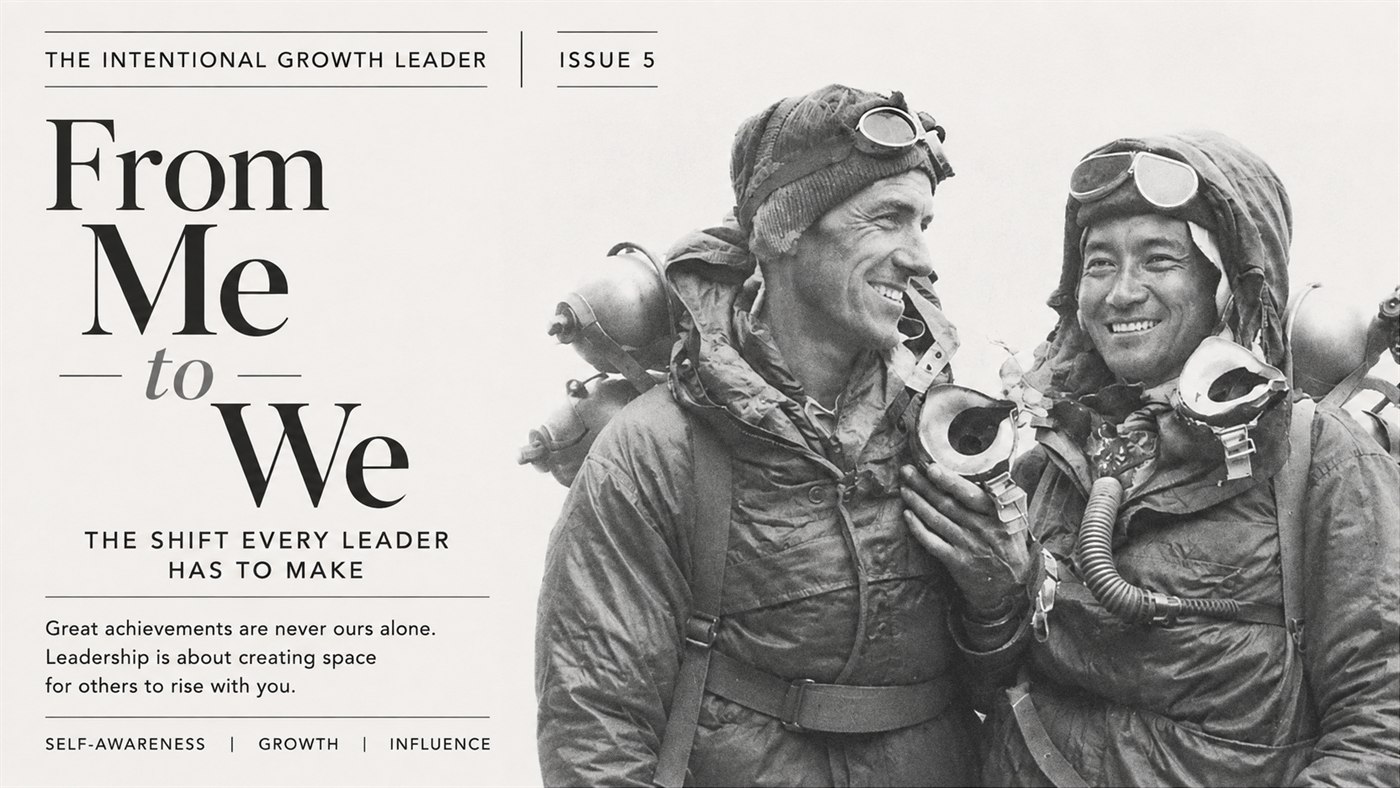
On 29 May 1953, Edmund Hillary and Tenzing Norgay became the first confirmed climbers to stand on the summit of Mount Everest.
For years afterwards, people wanted to know one thing.
Who reached the summit first?
It became one of the great questions surrounding the climb. Yet Hillary and Tenzing never seemed particularly interested in answering it. Rather than claiming individual glory, they consistently spoke of the achievement as something they had accomplished together. Reaching the summit mattered far more than who took the final step.
One of my favourite photographs from the expedition wasn’t taken on the summit. It shows Hillary and Tenzing standing side by side, still wearing their climbing gear, oxygen sets on their backs, both of them grinning. I’ve always thought it captures something profound about leadership.
The world wanted to celebrate an individual.
They remembered it as a shared achievement.
It reminds me that very few achievements are ever ours alone. Behind every success are people who encouraged us, challenged us, opened doors and created opportunities we could never have created by ourselves. The higher we climb, the more obvious that becomes.
I’ve come to believe leadership works the same way.
For much of my career, success was easy to measure. Working in sales, marketing and business development, we either won the project or we didn’t.
Early on, I thought winning the contract was the goal.
It wasn’t.
I soon realised that winning the work and keeping the client weren’t always the same thing. We’d secure a project only to lose the relationship later. The difference was rarely the sale itself. It was everything that happened afterwards.
The results we achieve are rarely the work of one person. They reflect the capability, trust and ownership of the people around us.
As our responsibilities grow, so does the temptation to step in. We care deeply about the outcome, so we answer the question, make the decision or solve the problem ourselves. We do it because we want to help. We do it because it’s quicker. Sometimes we do it because we know we can.
The trouble is, every time we step in too quickly, we step between someone else and the opportunity to grow. We solve today’s problem, but we don’t develop tomorrow’s leader.
If everything runs through you, your team never learns to run without you.
And if everything runs through you, you don’t really have a team.
You have an audience.
One of the leaders who had the greatest influence on my career understood this instinctively.
I was new to the business, and we were meeting with one of his long-standing clients. He had built the relationship over many years and knew the client far better than I did. It would have been easy, and perfectly understandable, for him to lead the conversation.
Instead, he encouraged me to take the lead while he stepped back.
At the time, I simply saw it as trust.
Looking back, I see it as leadership.
He understood that the client didn’t need greater confidence in him. They needed confidence in me. By creating space for me to build that relationship myself, he gave me an opportunity to grow that I might not otherwise have had.
It’s a lesson that has stayed with me throughout my career.
Years later I came across one of John Maxwell’s Laws of Significance:
One is too small a number to achieve greatness.
It didn’t teach me something I didn’t already know. It simply gave language to something I had already experienced.
The best leaders understand that their greatest contribution isn’t what they accomplish personally. It’s what they enable others to accomplish. They don’t measure success by how indispensable they become. They measure it by how capable the people around them become.
That’s the shift every leader eventually has to make.
Early in our careers, we create value through what we know, what we can do and what we can achieve ourselves. Leadership, however, asks a different question. Not, What can I accomplish? but, How can I help others accomplish what they couldn’t have achieved without me?
That’s the difference between adding and multiplying.
Adding is achieving success through your own effort.
Multiplying is helping other people achieve success without depending on you.
It requires patience, trust and the willingness to let others learn through experience, even when stepping in would be easier.
Looking back, the leaders who shaped my career all had one thing in common. None of them needed to be the hero. They shared opportunities, gave away responsibility and found genuine satisfaction in watching others succeed.
Perhaps that’s the real shift leadership requires.
We stop measuring success by what we achieve ourselves and begin measuring it by what we enable others to achieve.
Leadership isn’t about reaching the summit alone.
It’s about helping more people stand there with you.
That’s the journey from me to we.
Reflection
Who gave you room to grow when it would have been easier for them to step in?
Have you ever thanked them?
Intentional Action
If not, perhaps you can reach out today and thank them!
Are you growing on purpose, or by accident?
Twelve questions, four minutes. See where you’ve quietly plateaued - then download the free 44-page Growth Guide.
Take the Leadership Growth Check