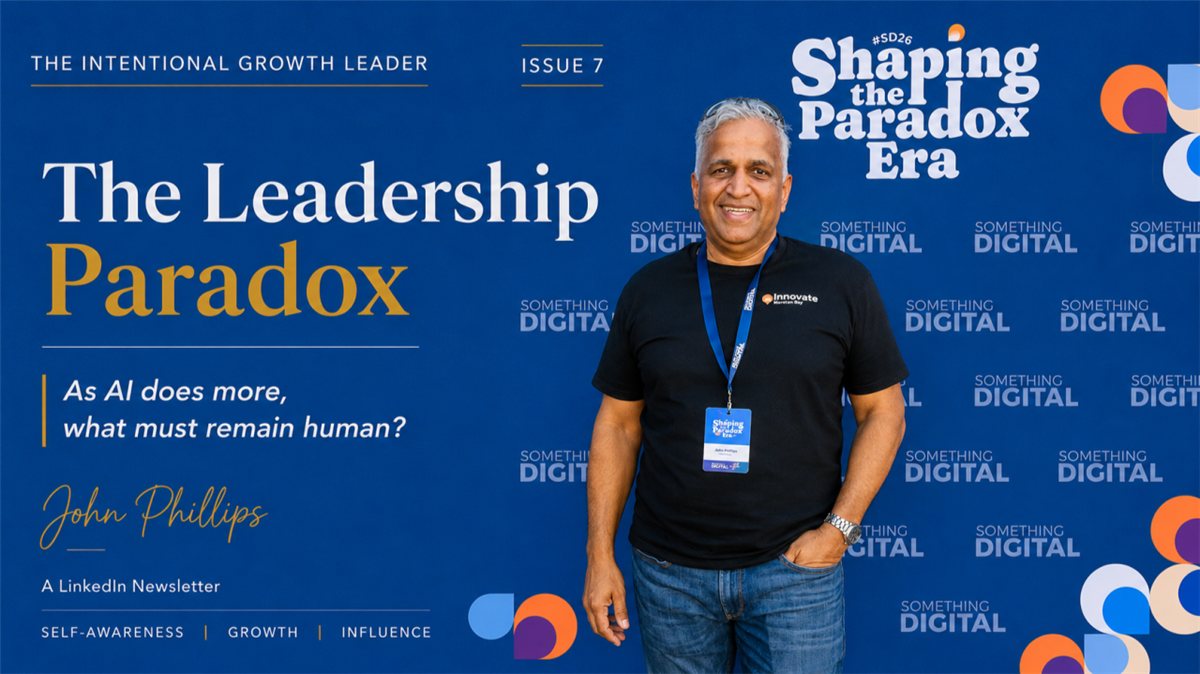
Last week in Brisbane, I was part of the Team Moreton Bay delegation at SD26, Something Digital 2026.
Two days of conversations about AI, automation, digital transformation, accessibility, agents, governance and the future of work left me thinking less about technology and more about people and leadership.
The theme was “Shaping the Paradox Era”. The more I listened, the more I realised how many of the challenges in front of us sit between two things that appear to contradict each other.
We have more information than ever, yet it can be harder to know what is true. We are more connected than ever, yet many people feel increasingly disconnected.
These aren’t contradictions we can simply resolve. They are tensions we have to learn to hold and lead through.
1. More intelligence. More judgement.
One session that caught my attention was “The Agentic Paradox: When Your Next Customer Isn’t Human.”
We’ve spent decades learning how to persuade people. Build the relationship. Tell the story. Make the case.
But an AI agent approaches a decision differently. It can check, compare and verify against criteria.
One line from the session stayed with me:
The machine pays for trust, not specs.
That made me think about how leadership changes when intelligent systems increasingly participate in decisions.
We have more information and better tools, but that doesn’t remove the need for judgement.
It increases it.
The ability to ask “Is this right?” becomes more important than simply knowing “Is this possible?”
And that requires self-awareness. Knowing our assumptions, recognising our biases and understanding when to trust the information in front of us and when to question it.
As technology becomes more intelligent, leaders need to become more conscious of how they think, decide and influence others.
2. More capability. More clarity.
One of my favourite moments at SD26 wasn’t actually about AI.
It was a Mastercard case study called Where to Settle.
When Ukrainian families arrived in Poland in 2022, many headed to the big cities. Those cities quickly filled up, making housing and work harder to find.
Mastercard’s anonymised spending data showed what life actually cost across different parts of Poland. Combined with figures from the Polish Central Statistical Office, it helped create a tool that allowed families to compare places to live.
By answering a few questions, people could see where they might realistically afford to live and find work.
More than 300,000 people used it, and 92% of the Ukrainians who engaged with it said it was useful.
What struck me wasn’t the technology.
It was where they started.
They didn’t begin with, “What could we do with our data?”
They began with, “What problem could we help solve?”
The data was the capability. The human problem was the purpose.
That distinction matters because it is easy to become fascinated by what technology makes possible and forget to ask whether it actually matters.
The leadership challenge isn’t simply having more capability. It is having the clarity to know where that capability should be applied.
Are we using technology because it is useful, or because it is new?
Read the Mastercard Where to Settle case study
3. More scale. More trust.
Another session explored “Scale, Trust and the Humans in Between.”
One observation captured it:
Scale is the easy part. Trust is the hard one.
Technology makes it easier to reach thousands, automate interactions and build systems that serve millions. But scale doesn’t automatically create connection.
The discussion around accessibility gave me another idea:
Edge users are your R&D team.
People who experience a product or service differently can expose problems the majority may simply learn to work around.
Instead of designing only for the average user, what if we deliberately listened to the people at the edges?
They can reveal our blind spots.
Sometimes the person who is hardest to accommodate is the person who teaches us the most.
That’s not simply an accessibility lesson. It’s a leadership lesson about who gets heard.
Influence isn’t simply about having the loudest voice. It is about understanding people well enough to create connection, build trust and move people towards something that matters.
4. More automation. More responsibility for people.
Another conversation asked what skills matter when AI is doing more of the work.
AI can remove repetitive tasks, accelerate research, create content and augment our capabilities. That’s exciting.
But people don’t develop simply by getting better answers.
We develop through experience. Judgement comes from wrestling with difficult problems. Resilience comes from setbacks. Confidence comes from making decisions. Creativity comes from experimentation. Leadership comes from navigating ambiguity.
If we automate every difficult part of work, we risk removing some of the experiences through which people grow.
The answer isn’t to resist AI.
It is to become more deliberate about what we automate and what we leave people to learn.
As technology does more of the work, leaders have to become more intentional about developing the people who use it.
What I learned this fortnight
- Start with the problem, not the technology. The best use of capability begins with something that genuinely matters to people.
- Trust becomes more important as technology becomes more capable. When the presentation is stripped away, what remains is what we actually do.
- Self-awareness becomes a leadership advantage. The more intelligent the tools around us become, the more important it is to understand our own assumptions, judgement and biases.
- People still need opportunities to grow. If technology takes over more of the work, leaders have an even greater responsibility to build judgement, confidence and capability.
- Influence starts with understanding. In an increasingly automated world, the ability to listen, connect and bring people with us remains deeply human.
The paradox isn’t something we need to solve.
It is something we need to learn to lead through.
Technology will continue to give us more options. Leadership is about deciding which ones are worth pursuing, who they serve, and what we must protect along the way.
What should we do with what technology makes possible, without losing what makes us human?
Proud to have been part of Team Moreton Bay at Something Digital 2026, and to have spent two days learning, questioning and thinking about what comes next.