
The Intentional Growth Leader · Issue 4 · 21 July 2026
The Poleng Principle
Why success needs failure, and what I learned from the Balinese about leadership.
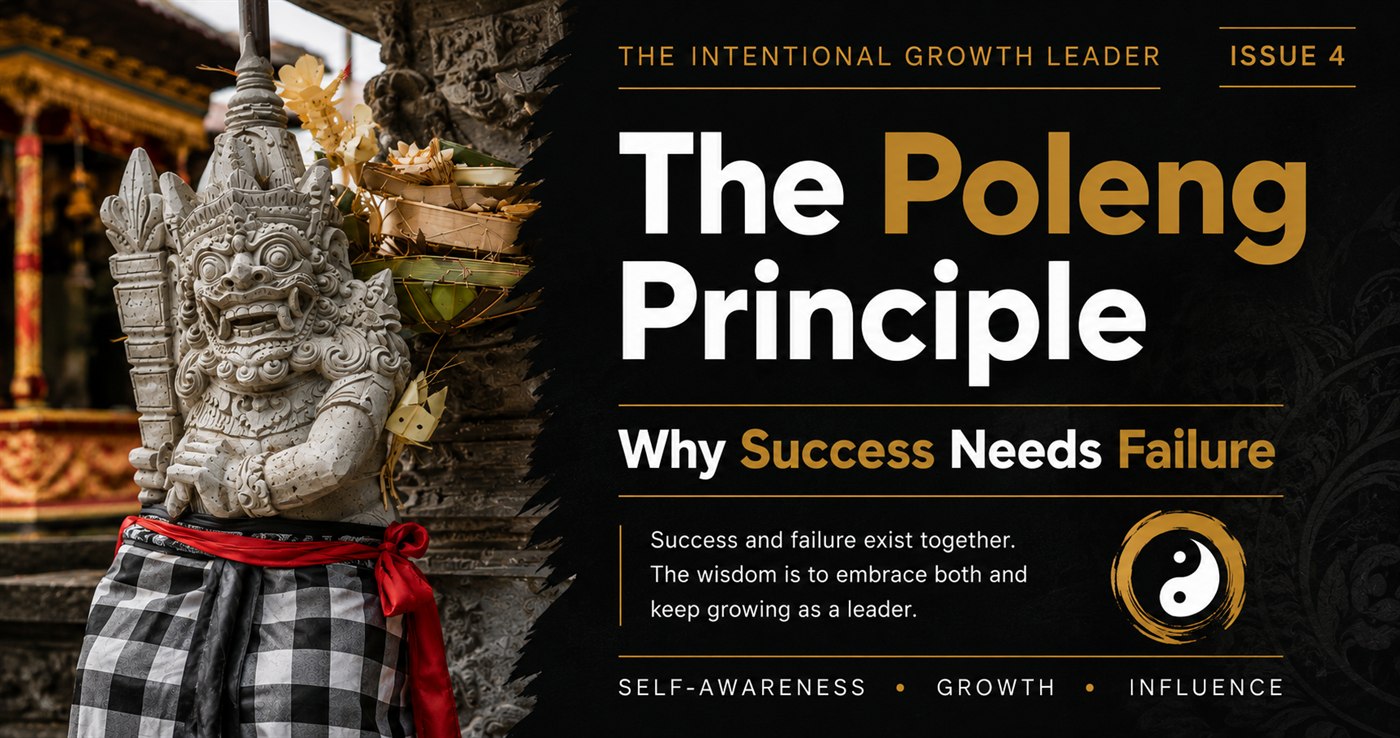
During my time in Bali, there was one symbol I couldn’t stop noticing.
Every day I’d see the same black-and-white chequered cloth wrapped around ancient banyan trees, draped over temple statues, surrounding shrines and even worn during ceremonies. It seemed to appear wherever I went.
Eventually, curiosity got the better of me.
What does that cloth mean?
The answer surprised me.
The cloth is called poleng, and its black and white squares aren’t about one overcoming the other. They represent life’s opposing forces existing together. Light and darkness. Joy and sorrow. Strength and vulnerability. Success and failure.
The Balinese believe harmony isn’t found by eliminating one side, but by recognising that each has a purpose and each gives meaning to the other.
Standing there, I realised I wasn’t just looking at a piece of cloth.
I was looking at a leadership principle.
For much of my life, I thought success and failure were opponents.
Success meant I was winning.
Failure meant I had somehow lost.
The more I reflected on the poleng, the more I realised that wasn’t true.
The real danger isn’t failure.
The real danger is separating success and failure.
We tend to make success the hero of our lives and failure the villain. We pursue one and avoid the other. We celebrate our wins, hide our mistakes and quietly hope nobody notices when things don’t go according to plan.
Yet life rarely gives us the luxury of experiencing one without the other.
You can receive a promotion while caring for an ageing parent.
You can build a thriving business while struggling with your health.
You can experience disappointment at work while enjoying the richest season your family has ever known.
Success and failure don’t usually take turns.
More often, they coexist.
Just like the black and white squares of the poleng.
When we separate them, we lose perspective.
Success on its own can be surprisingly dangerous. Bill Gates captured this well when he wrote:
Success is a lousy teacher. It seduces smart people into thinking they can’t lose.
Success can quietly make us less curious, less grateful and less willing to ask the difficult questions that keep us growing.
Failure has the opposite effect.
It exposes blind spots.
It challenges our assumptions.
It reminds us that we still have more to learn.
Yet failure on its own can become equally dangerous if we allow it to define us. Without the perspective that success is still possible, failure can lead to discouragement, fear and hopelessness.
Neither success nor failure tells the whole story.
Together they do.
That’s one of the reasons John Maxwell’s Failing Forward has influenced me so deeply.
John reminds us that failure is an event, never a person. Every leader experiences setbacks. The difference is not who fails, but who chooses to learn.
He also writes:
Experience isn’t the best teacher—evaluated experience is.
That sentence has stayed with me for years.
The greatest lessons in my own leadership have rarely come from success alone. They’ve come from slowing down after disappointment and asking better questions.
What happened?
What did this reveal about me?
What will I do differently next time?
That’s how we get a return on failure.
Not because failure is something we seek, but because it has something to teach.
Looking back over my own journey, many of the experiences I once wished hadn’t happened became the experiences that prepared me most.
Closed doors.
Unexpected changes.
Plans that unfolded differently from what I imagined.
At the time they felt like setbacks.
Looking back, they were preparation.
Success gave me confidence.
Failure gave me humility.
Success opened doors.
Failure prepared me to walk through them wisely.
Neither could have accomplished the whole job on its own.
Perhaps that’s why the poleng has stayed with me long after leaving Bali.
The black squares don’t weaken the cloth.
They complete it.
Leadership is much the same.
Success without failure can produce pride.
Failure without hope can produce discouragement.
Held together, they produce perspective.
Perspective produces wisdom.
Wisdom produces growth.
And growth shapes leaders.
As Grantland Rice wisely wrote:
Failure isn’t so bad if it doesn’t attack the heart. Success is all right if it doesn’t go to the head.
To me, that’s the Poleng Principle.
The goal isn’t to pursue success while avoiding failure.
Nor is it to glorify failure.
The goal is to embrace both with humility, gratitude and perspective, recognising that together they are shaping the leader you are becoming.
Reflection
Where in your life are success and failure existing side by side today?
Leadership can feel lonely when things aren’t going to plan. If you know someone in that season, share this with them. It may be exactly the encouragement they need today.
Intentional Action
This week, identify one success you’re celebrating and one disappointment you’re carrying.
Write down what each one is teaching you.
You may discover that both are contributing to your growth.
Are you growing on purpose, or by accident?
Twelve questions, about four minutes. An honest read on where you’ve quietly plateaued, and the one area setting the ceiling on the rest.
Take the Leadership Growth Check