The law that’s quietly working against you, and why standing still is really going backwards.
One of the concepts I remember from my chemical engineering days is entropy.
In simple terms, entropy helps explain why things naturally move towards disorder over time. The Second Law of Thermodynamics tells us that the entropy of an isolated system tends to increase. Without energy entering the system, things gradually become less organised.
To maintain order, energy needs to be put in.
I think people work in a similar way.
When we stop taking in anything new – new ideas, new experiences, new perspectives, new people or honest feedback – we risk closing ourselves off.
We keep relying on what we already know. We repeat familiar routines, surround ourselves with familiar thinking and stop challenging our assumptions.
And just like any system that isn’t being replenished, we begin to deteriorate.
Our skills become outdated. Our thinking becomes rigid. Our relationships can weaken. Our personal growth slows.
When we stop letting new things in, we eventually stop growing.
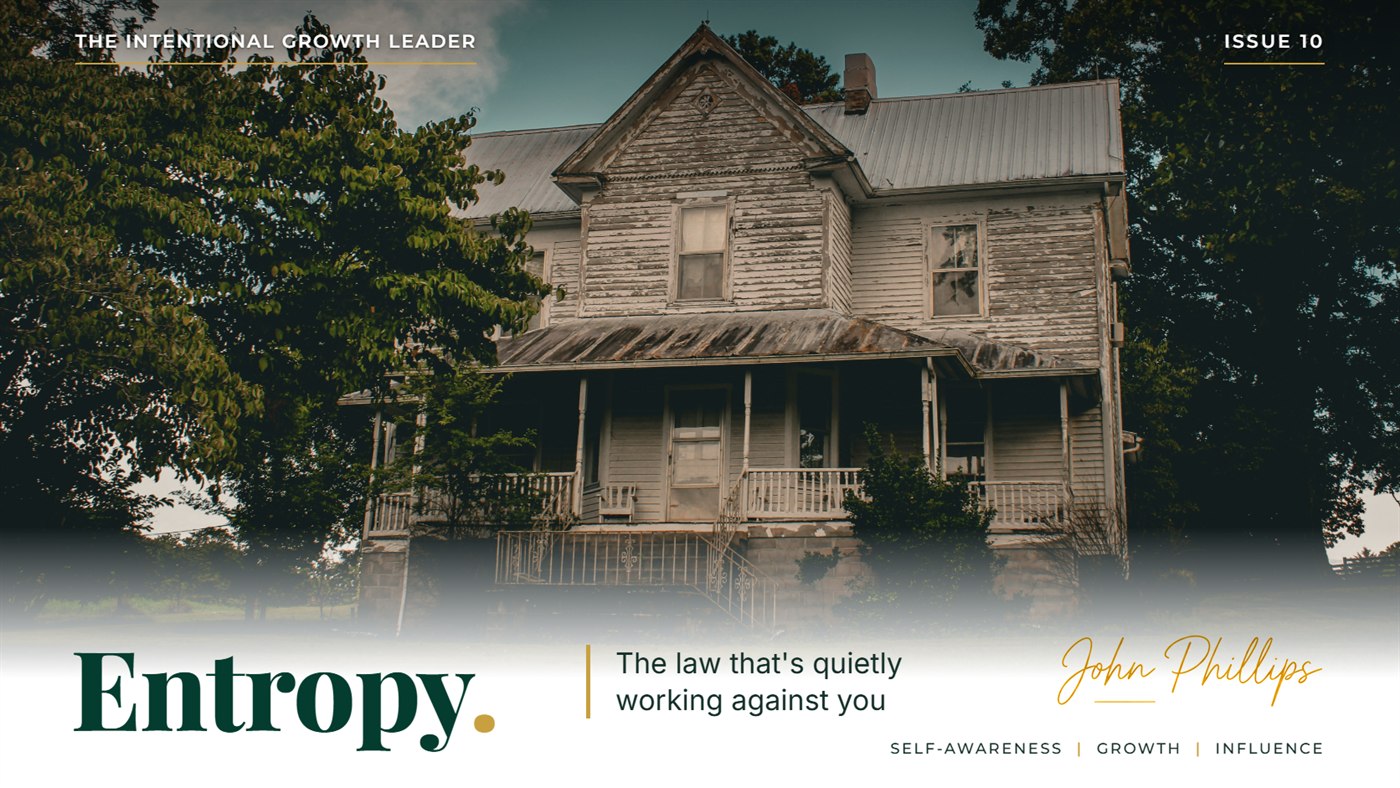
Think about a house that was once someone’s pride and joy. Without regular care and maintenance, the paint peels, the garden becomes overgrown and small problems gradually turn into bigger ones.
Nobody decides to let it fall apart. It happens through neglect, one small thing at a time.
I wonder whether the same thing happens to us.
When life is comfortable
We are fortunate to live in Australia.
We enjoy a relatively high standard of living, personal freedoms, beautiful beaches, national parks, open spaces and opportunities that many people around the world would love to have.
For many of us, life is pretty good.
But I wonder whether there is a downside to being comfortable.
When things are going well, what motivates us to keep learning, challenging ourselves and developing?
It’s easy to settle into a routine. We become comfortable with what we know, what we do and where we are.
Nothing appears to be wrong. We’re not failing or struggling. We’re busy, productive and perhaps even successful.
But are we growing?
Could we be so comfortable with where we are that we stop noticing how far we’re falling behind?
The quiet danger of complacency
Complacency rarely announces itself.
It creeps in gradually.
We stop reading and learning. We rely on experience rather than developing new skills. We become less curious and less willing to challenge our own thinking.
We can be busy without making progress.
We can be experienced without continuing to develop.
We can be successful without realising that we’ve stopped growing.
Chris Robinson explores this in his book From Drift to Drive: A High Achiever’s Guide to Breaking the Chains of Complacency, published by Maxwell Leadership.
He highlights how complacency can hide behind busyness and even satisfactory success.
Sometimes we don’t recognise that we’re drifting because everything seems fine.
But the world doesn’t stand still.
Industries change. Technology advances. Expectations shift. The knowledge and experience that served us well yesterday may not be enough tomorrow.
We drift without noticing.
Contentment versus complacency
There is nothing wrong with being content. We should appreciate what we have achieved and enjoy where we are in life.
But contentment shouldn’t become an excuse to stop growing.
We can be grateful for where we are while remaining curious about where we could go.
We can be happy with our achievements while recognising there is still more to learn.
We don’t need to be dissatisfied with our lives to want to become better.
The danger is when contentment turns into complacency, when we stop asking questions, stop challenging ourselves and become comfortable with simply repeating what we already know.
Growth requires intention
One of John Maxwell’s 15 Invaluable Laws of Growth is the Law of Intentionality: growth doesn’t just happen.
Experience alone doesn’t guarantee growth. Time passing doesn’t automatically make us better. And simply being busy doesn’t mean we’re developing.
Personal growth requires deliberate effort.
It means continuing to read, learn, reflect, seek feedback and put ourselves in situations where we are challenged.
Sometimes it’s about learning a new skill. Sometimes it’s having a difficult conversation, listening more carefully, changing a habit or being open to a different perspective.
The actions don’t need to be dramatic.
But they do need to be intentional.
Leaders need to keep growing
This matters even more for leaders.
We spend considerable time thinking about developing our teams, improving performance and achieving better outcomes.
But how much time do we spend developing ourselves?
It’s easy to rely on experience, assume we have the answers and become comfortable with the way we’ve always done things.
Yet leadership requires continuous development.
If we expect our people to learn, adapt and grow, we need to demonstrate the same commitment ourselves.
We cannot expect to take our teams forward if we are no longer moving forward ourselves.
A question worth asking
If we stop investing in ourselves, our skills, thinking, habits and relationships can gradually deteriorate.
We might not notice it immediately. There may be no obvious warning signs.
Until one day, we realise we’ve been standing still while everything around us has moved forward.